
Why We Sing Together (Part 2)
A Biblical Perspective on Congregational Corporate Worship
Chan Shealy

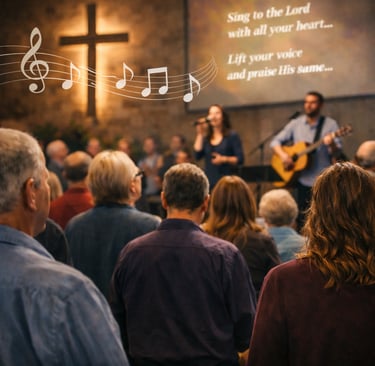
In Part 1, we explored why God calls His people to sing together through choir ministry. But choir is only one expression of a much bigger biblical idea: congregational, corporate worship. Scripture paints a clear picture—God’s people are meant to lift their voices together. And yet, in many churches today, you’ll see a wide range of participation: some sing joyfully and freely, while others stand quietly, watching. So why do some sing? Why do others remain silent? And what does the Bible say about it?
Singing Together Is God’s Design
From the earliest pages of Scripture, worship was never meant to be a solo act.
“Sing to the Lord, all the earth; proclaim his salvation day after day.” (1 Chronicles 16:23)
“Come, let us sing for joy to the Lord.” (Psalm 95:1)
Notice the language—all, us, together. Congregational singing is a shared response to God’s goodness. When the church sings, it becomes a unified testimony of faith, gratitude, and praise.
Why Some People Sing Freely
Many believers sing because worship has become a natural overflow of their relationship with God.
They sing out of gratitude for what God has done.
They sing as an act of obedience, responding to Scripture’s call.
They sing because truth has taken root—lyrics become prayers, declarations, and reminders of God’s faithfulness.
“Let the redeemed of the Lord tell their story.” (Psalm 107:2)
For these worshipers, singing isn’t about vocal quality—it’s about heartfelt response.
Why Some in the Congregation Do Not Sing
If we’re honest, many people struggle to engage vocally in worship. Scripture gives us grace to understand why.
1. Fear and Self-Consciousness
Some don’t sing because they feel inadequate or embarrassed about their voice.
“Man looks at the outward appearance, but the Lord looks at the heart.” (1 Samuel 16:7)
God is not listening for perfection—He is listening for sincerity.
2. Distraction or Weariness
Others are present physically but burdened emotionally, mentally, or spiritually.
“Come to me, all you who are weary and burdened, and I will give you rest.” (Matthew 11:28)
Sometimes silence isn’t rebellion—it’s exhaustion.
3. Unfamiliarity with Songs or Style
When songs are unfamiliar or feel stylistically distant, people may hesitate to participate. This reminds worship leaders and churches of the importance of teaching songs and choosing music that invites the congregation rather than isolates them.
4. Viewing Worship as Observation Instead of Participation
Modern culture often trains us to consume rather than contribute. Worship can unintentionally become something we watch instead of something we do.
“Let everything that has breath praise the Lord.” (Psalm 150:6)
Congregational worship calls every believer to engage—not just listen.
Singing Is an Act of Faith, Not Feeling
The Bible never ties worship to mood—it ties it to truth.
“I will praise the Lord at all times; his praise will always be on my lips.” (Psalm 34:1)
Sometimes we sing because God is good. Other times we sing until our hearts remember that He is.
Corporate Singing Builds Unity and Strengthens Faith
When the church sings together, faith is reinforced.
“Speak to one another with psalms, hymns, and spiritual songs.” (Ephesians 5:19)
Notice that worship isn’t just directed upward—it also strengthens one another. When one voice falters, another carries the song.
Congregational Singing Is a Witness
Corporate worship proclaims the gospel not only to believers, but to the watching world.
“Declare his glory among the nations.” (Psalm 96:3)
A congregation united in song testifies that God is worthy—together.
A Pastoral & Worship Leader Reflection
As a worship leader, I’ve stood on the platform and seen both lifted hands and folded arms, open mouths and silent hearts. And I’ve learned something important: silence doesn’t always mean disinterest, and singing doesn’t always mean surrender.
But I also know this—God invites every believer into the song. Not because He needs our voices, but because we need to declare truth together. Singing shapes our faith, aligns our hearts, and reminds us that we do not walk with Christ alone.
If you struggle to sing, know this: God is not grading your voice. He is welcoming your obedience. And if you sing freely, remember that your voice may be the very thing that gives courage to someone beside you.
My prayer is that our churches would grow into places where worship is not watched, but shared—where every believer understands that when the people of God sing together, heaven listens.
“Let the word of Christ dwell among you richly… singing to God with gratitude in your hearts.” (Colossians 3:16)